

WINTER 2026, SHORT STORY, 1900 WORDS
Prefer to read this as an EPUB or PDF?
Join our Patreon and instantly download issue 41:
Will this letter reach you? I don’t know yet.
That’s the familiar response. It’s the answer that passes responsibility for my words to time. Time, the inarguable overlord of our relationship, all relationships. But you know me well, you always have. I like the familiar. You sigh at how I guard our sacred Sunday mornings and hold their pattern inviolable. I won’t change our schedule. Waking up late and walking for an hour through the city sees both of us at our best.
For you and me, the Sunday morning city is a forest.
Me, in a reverie provided by the well-worn path, as if springy earth had been tamped down over the years of our predictable travels, leaf mulch under our feet. Buildings long established, dates on the façades, tall and straight as trunks. And you, pointing out the smaller details, looking left and right for wondrous ephemeral things, the tight yellows and pinks, blue stripes and red caps of the joggers like the flashes of bright birds across the journey. The Sunday expedition to our regular coffee shop for brunch. Some places find their power in being the destination: the aftermath of the arrival. The quiet ground. We always talk well to each other over brunch.
Your hair is a mess from the crosstown wind, it has worked free from its clip, curling where it hits your shoulders, and you are alive, alert, and ready to order something special. A celebration. Of what? Of seeing a lesser-spotted rollerblader, speedy, nimble, dressed in a polka-dot one-piece and cheeping along to the music in their head. But I want to stick to the usual, so we do.
You say you’d like to live in a forest. But you laugh at yourself, you know it’s ridiculous. You like your contemporary comforts and your job, too. You don’t want to spend the time commuting. You say you’re too lazy to have things any other way, and I agree, but it worries me. Am I the easy course of action, too? The comfortable, if not spectacular
I’m off track. I’ll start this letter again.
I want to sit at this table, in our usual coffee shop, and describe to you what the city looked like this Sunday morning, after I left the apartment. That hour of walking. Because we always thought the city and the forest were irreconcilable, which was why we played the game of imagining one as the other. Two completely different ways of living. What I mean by that is
I’ll start again again.
We take a midweek trip to the New Forest, on the South Coast. It’s two hours away. We sit on either side of the table in a busy carriage on a slow stopper train, and watch the way the view unscrolls, as if cranked mechanically in front of the window. We move from the gleam of the new developments of the city to the small rows of houses, their gardens holding forgotten play equipment and the skeletal remains of last year’s Christmas trees. Then sudden breaks of open fields, expanse of sky with scudding clouds that threaten yet more rain, and swollen rivers, and foliage half-swallowed in ponds, and yes it rains every day we spend in the New Forest and we walk so far in it, joking that what it really needs is a coffee shop. But jokes are rare, there. You’re not a fan of jokes, really. You like the sound of rain on cupped leaves, running down the ragged lines of the trunks, wet and rough. I think the sound of rainfall is not so different from the lull of night traffic through our bedroom window, always left ajar. Both can lull me to sleep.
Today the coffee shop is playing light jazz, peppered with tinkling piano. I’ve ordered our usual: a sharing plate of pancakes with cream and mixed berries. The berries are sour in the spring. There’s a daffodil in a vase on every one of the round silver tables, and scattered newspaper supplements to pick up at leisure. On the table next to me there’s a fashion pull-out, models preening. The date shows it’s from the week before. I’m so tired. Waiting for the caffeine to kick in.
The city. We were so wrong about the city. We thought it was unconquerable, concrete, written in stone, cement and estrangement. We thought we belonged to it: to urban glass and metal expectations.
You say to me—a rare comment to break the sound of the endless rain on the leaves—that you could stay here forever, a creature of the New Forest. I point out that you wouldn’t last a day. Which berries are safe to eat? I point to a bush of dark long leaves and bright red punctuations. You tell me you’ll stick to the berries on Sunday morning sharing pancakes. For some reason this comment makes me remember that your parents are richer than mine. I come from the poor side of the city, and for a moment I think that might translate to survival, as if I can outlast you in any situation.
Well. We both now know that’s true.
I’ll start again.
I want to write about my walk through the city, from front door to coffee shop. One hour of walking. The berries are sour, the pancakes sweet, the coffee rich, a little bitter, as always, and the hit of the caffeine is coming, it’s beginning to seep through the crack of the window. Listen, here’s the thing, you fucking idiot, you have always lived in the forest, you’re alive in it now. I can see you.
You’re also lying in the ground in a tasteful facility where they planted a tree on top of you, and your mother asked what kind of tree you would have wanted and I had to admit defeat, to say—after my insistence upon the tree burial idea, she loved trees, she was always happiest among trees—that you have never once named a specific tree as your favourite and you know nothing about trees, not really, except that you once went on a holiday to the New Forest and liked the sound of the rain on the cupped leaves, and liked the feel of bark under your fingers. Your mother chose apple. The man at the tasteful facility said apple saplings tend to do well, although roughly a third of all the saplings don’t take, but when that happens, they’ll provide a replacement sapling for free.
Your mother asks me if I’m certain this is what you wanted, and I tell her I don’t know yet. But perhaps that’s not quite true. You loved the forest, you wanted to live in the forest. It’s only that I couldn’t bear to take what remains of you to the New Forest and surreptitiously slip you under the trees, then take a two-hour stopper train back without you. I want you close. I continue to want you close.
Yes, this is a letter to tell you: I’m so fucking angry.
The city, you love it, you won’t admit it, our life is here, in the city. You belong to it because you belong with me. You say everything is fresh and whole and perfect in the forest, breathe it in, breathe deep, and you breathed deep, but you were already compromised, the disease had slipped in through the crack in the window and put its roots inside you. You never belonged in a forest. I have no idea why I insisted on putting a tree upon you. It’ll probably feed on your remains, take on your sickness, and die. We’ll be replanting in less than a year. If you ever loved me, you loved the city. The city as it was, for us, before it changed.
I’ll start again.
This morning, as soon as I set foot outside the front door, I knew the city was different. Not to look at, not at first. But it was inside me, this realisation that I was not looking at the same street, the same shop windows and parked cars with permits, and the same full bins and ripped billboards, even though they are the same to see, with the surface level unaltered.
I locked the door and started walking, and it occurred to me that I felt this alteration not in my core, or any comfortable idiocy of that kind, I don’t believe in that, you know I never have, but the change was radiating up through my feet. My soles rather than my soul, if you like, although you would have rolled your eyes at that joke. My letter, my rules. No, the city had changed below its visible layer, deep in its foundations.
I crossed at our usual spot, where the cars slow to turn into the multi-story, and I dodged between the joggers and rollerbladers along the riverside way. With every step the feeling increased, and by the time I reached the third blue bench I couldn’t ignore it any longer. I sat and let the rhythm of the change beneath me surge: soles, ankles, knees, hips, heart. I put my hand on my chest and breathed in time. It wasn’t enough. I had to get closer. I moved from the bench to the ground and lay flat, face down, my forehead on the asphalt between the bench and the nearest bin. I could smell the many discarded things in the bin, mingling, making a familiar scent of dog poo bags, beer cans, fast food wrappers, encasements, disposables, all above ground and intact, reeking of city life, but below, below, the city was newly aware of me, and growing.
A voice asked me if I was okay.
Imagine that, in this city.
I sat up and said I was. The jogger was a common grey warbler with blue cap. He nodded and moved away, resuming his comfortable pace, and I knew then that what was happening below was affecting above, in a good way. Cities have roots, and roots grow and change and convey their messages, and push their energy into the structures above.
I noticed a small plant growing through a crack between the kerb and the road, using the shelter of the bin. It was nothing more than a springy stick with one long leaf. A possibility. A sapling? I don’t know yet. Maybe it’ll turn into a tree. And I stood up and looked around and saw shoots of green everywhere, dotted like a pattern, a puzzle to be solved. Weeds in the cracks, lifting the heaviest stones.
That is the change in the city. That is the change in me.
You’re part of this change. I sense your cupped hand in it. I feel you listening. I’m aware of you, under the soles of my feet. I was right to plant you, close, like a possibility.
The coffee is wearing off. I’m tired again. It’s a long walk back across the city, alone, but there will be green spring growth for company.
I want to write you a letter about how you belong to the city and the forest. You are both, because one day they might be the same thing. Does that make sense? I don’t know yet.

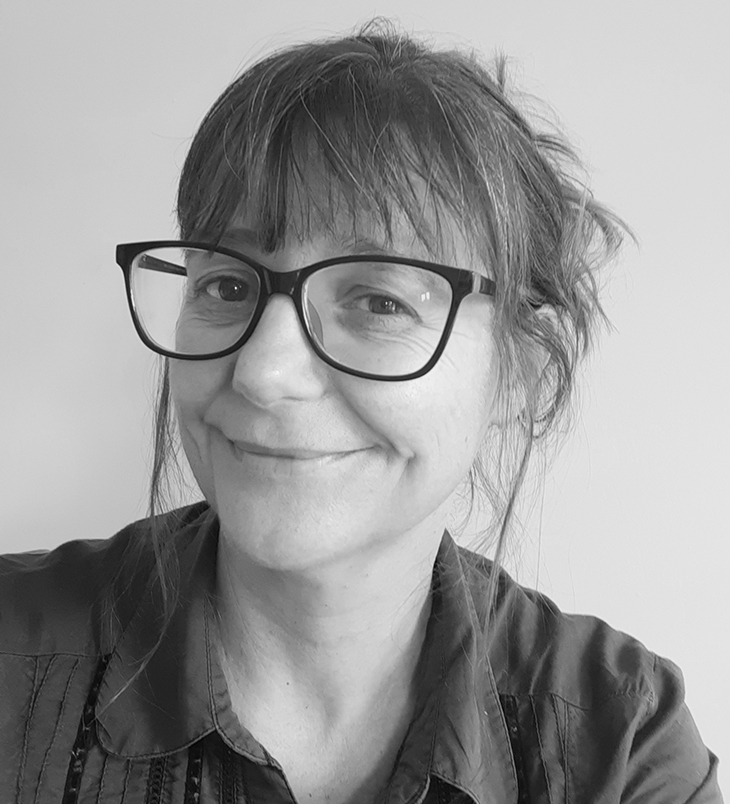
Aliya Whiteley’s stories have been shortlisted for multiple awards. Her future-fantasy travelogue, Three Eight One, was published by Solaris in January 2024 and won the BSFA award for Best Novel, and her new fantasy/SF novel, The Misheard World, will be published in February 2026. Her short fiction has appeared in many places, most recently as a collection on the subject of transport called Drive or Be Driven. She lives in Sussex, UK, and blogs regularly about plants, planets, and other strange things at aliyawhiteley.uk.
