

SPRING 2026, SHORT STORY, 3400 WORDS
Prefer to read this as an EPUB or PDF?
Join our Patreon and instantly download issue 42:
The dog dies on Christmas Eve. I spot its body at dawn: a dark, peculiar smudge on the hillside I first mistake for a fallen oak branch blackened with rain.
It’s not really a dog; we just call it a dog for lack of other things to call it. We call it a dog the way Christians call church collapses and wars and children with cancer “divine mysteries.” Calling it a dog and loving it anyway is kinder than a question mark. Kinder than calling it an abomination. Kinder than saying we don’t know.
I drink my tea as the sun comes up and try to convince myself that the dog isn’t really dead. The shape is half-obscured in the mist that rises from the earth in waves as the night’s frost melts away, it could be anything. A sleeping bear. A pile of logs. A heap of dirt. A wasted drunk, an escaped convict, a fragrant vagrant. But by mid-morning, the sun has come to burn the fog off, and it becomes unmistakable. There is something so uniquely still about a dead animal, and there is something so uniquely un-doglike about the dog.
By noon, you’ve woken, bruise-purple half-moons beneath your eyes, your hair in opposing directions. I imagine us ten years ago, the way I could have reached out, idly smoothed a cowlick down with my hand without overthinking it. But it’s not ten years ago, it’s now, so instead, I sit at one end of the couch, you on the other. Neither of us have turned on the Christmas lights, so the tree is dark in its corner of shadow, its skirt askew and needles littering the hardwood.
“Something’s died on the hillside,” I tell you, a loathing like cement in my guts.
“A deer?” you ask. It wouldn’t be the first time one was hit on the road and hobbled to our property to bleed out. We’re not far from the single winding highway that cuts through this part of the mountains, and the woods that border the property are thick with whitetail. But I think of that shape cut out against the horizon, and I shake my head.
“…I think it’s the dog.”
We sit in silence until you finish your coffee, then we walk out past the oaks and the granite and the creek. Where the sun touches the ground, the fallen leaves are chewed up to a red-brown mulch, but in the shade, they’re still yellow, frozen. Arrested in time and encased in ice. Death without decay, a pause before Mary’s labor, the babe born only to die.
“That’s the dog all right,” you say once we’re near enough to confirm. You freeze in your tracks, but I grab a stick and creep on. I have never been so close to the dog before, and part of me still expects it to spring to its feet, show its teeth before it lopes into the underbrush. We could laugh together then, something we haven’t done in so many months. God, remember that day we thought the dog died? What fools. As if that thing could be anything but immortal. Imagine life without it—I can’t, can you?
Dead, it is more clearly Not a Dog than ever. I crouch beside its hulking body, prod it with the stick. Black leathery skin, wiry hackles like a hyena. We used to think it was an enormous coyote with mange back when it only skittered around in the distance, refusing to jump the fence and snuffle closer. But then when the winter came, it started venturing nearer to the house, and we stopped trying to guess what it was or to come up with theories. It became simply “the dog,” the misnomer a banal smokescreen for a magnificent miracle.
There’s a swollen sac on its back, the illusion of something moving inside just beyond the fluttering skin layer of semi-translucence. Wings hidden behind a membrane, the joints and feather pinions black, sparse. I lift a forepaw with the stick—its legs go the wrong way, they’re gnarled, like a rooster’s feet with claws jutting from three talons, spurs on the heels. They emerge from a cluster of bleeding pinfeathers, ragged like it was mid-molt. When I pull back dark lips, it has teeth like a goose in its muzzle.
“Don’t touch it,” you scold.
“Why? It’s dead. It can’t hurt me.”
“You don’t know that. The rabies virus stays alive in an infected animal’s saliva for—”
“It wasn’t rabid,” I say, studying its graying snout. “It was just old.” Then, after a beat, I wipe my dirty hand on my sweats. “We should bury it.”
“The ground’s too hard this time of year,” you remind me. “For a hole that big, we’d need an auger.”
My throat gets so tight I can’t speak around it, so I make a fist in my pocket and wish you were anyone but you. I’d take the pimply hacker coworker who stole and sold my nudes. The ex who cheated on me with his teen student. My mother. My dying father. Then I remember my father isn’t dying anymore—he’s already dead.
“Fine,” I snap. “I’ll cover its body with pine needles or whatever. You don’t have to help.”
But you do, grudgingly. For an hour, we wander the property in silence, bringing back armfuls of sodden leaves, broken branches, flakes of ponderosa bark. You pile yours a safe distance away from the body for me to deliver them that final stretch and dump them atop the dog.
“Are you crying?” you ask at one point, as I wipe my nose on my sleeve.
I realize I am. This is a new, strange sort of grief: burying an animal when the ground is too hard to dig into. Burying an animal that was not a pet, that is no identifiable species, but that shared space with us all the same. The dog and I had a ritual, and I loved it for that, I think. It would get into our trash if we didn’t leave it offerings, so I fed it on the hillside. Hauled grocery bags full of onion skins and chicken fat I’d trimmed for dinners, carrot peelings and potato eyes and whatever had expired in the fridge. It loved rotten food. It would lick tupperware clean, warily eying me with its reflective yellow eyes, pinpricks of black at the center like bullet wounds.
Once the corpse is covered, I kneel beside it until the wet soaks through my sweatpants. You return to the house, and once I’m alone, I say a small, secular prayer for the dog. You made my lonely feel less lonely. Thank you, for that. Then, tacked on like a last-minute purchase in line at the grocery store—chapstick, candy, gum—I wish it hadn’t been you.
I sit there for a long time. In December, it’s too cold for the flies or the yellow jackets to come, and even in direct sunlight, the body doesn’t smell. It’s a cold sun, a clean sun. The dog might have just laid down and gone to sleep, one of the incorruptible saints in a glass case in some Italian cathedral, its flesh bejeweled in a crypt.
Eventually I start to shiver, so I hike back up the hillside, sniffling. When I return, you’re back in bed with the door closed, and the Christmas lights are still off. I flick the switch reflexively, festooning the tree in pinpricks of gold. They slant and wobble as I squint with wet eyes, like uncertain figures poised to bolt.

“I’ll serve him the divorce papers after the holidays,” I told my mother when she visited last summer. “It seems kinder that way.”
Kinder, like a mercy killing. Kinder, like calling the dog a dog. When my dad was dying in hospice, he asked to have his bed moved downstairs to the conservatory so he could watch the birdfeeders swarm with finches, cardinals, robins, towhees. They were so plentiful that year they would hit the polished windows, lie dazed in the gravel paths bisecting the garden outside. He hated seeing them suffer, so if they didn’t recover and fly off, my mother would go outside and collect them, wring each one’s neck in the garage before tossing them in the compost bin. Piles of finches, cardinals, robins, towhees. So many shades of red and brown and more red. It needs to be done, she said. Someone has to do it. I didn’t inherit her cold brand of compassion—my M.O. was to let things stagger around too long, until they grew half-mad with pain.
“What’s one last Christmas if you’re both unhappy!?” she’d asked, gesturing brusquely with her cigarette. “You’ll remember it as ‘the Christmas I knew I was leaving my husband.’ Not very merry.”
“I’m scared he might hurt himself,” you admitted, and she’d scoffed at you.
“Baby, he only wants you to think that. It’s how he keeps you catering to his every whim. He can’t get a job because he’s depressed. He can’t help around the house because he’s depressed. You can’t leave because he’s depressed. You’re stuck, right where he wants you, because he’s too goddamned fragile for you to feel like you can push him out the door. This isn’t a bug, it’s by design. He’s not actually sick, he just wants to be a toddler forever.”
I know she’s right, my no-nonsense mother and her bird-killing hands. She’s coming tomorrow for Christmas dinner, alone now that my father has passed. Alone but not lonely, she thrives in her new solitude; she’s started spinning classes at the gym, she walks in the park, she goes on cruises to Acapulco and Baja and comes back with a tan. Dying was the best thing he ever did for me, she liked to say in her smoker’s laugh.
I am baking spiral-cut ham in honor of her visit and Jesus’s birthday. It sits in the fridge wrapped in crackling pink foil, and to make room for this intrusion, I cleaned out the forgotten back layers of ancient sauces and crystalized jelly jars and leftovers too encrusted in hoary mold to even recognize. Just a few nights ago, I leaned against a tree as dusk descended and watched the dog from a safe distance as it chased the last amber tablespoon of chutney with its long, dexterous tongue. The image makes me choke up to recall. I sit in the bathroom, my head between my knees, and imagine those wings that never unfurled.
“I don’t think it matters if you wait for Christmas or not,” my mother told me. “I think it’s going to play out with the same melodrama no matter when you do it.” Then a barking laugh, her green eyes glittering the way they always did when she was about to become her meanest, most unrepentant self. “Wouldn’t it be more convenient if he just died like your father? Divorce is so expensive.”
I had the papers in my locked desk drawer, I thought about giving them to you then, haunted by my mother’s tasteless joke. I could serve you before the chill of winter, before the ground froze too hard to bury anything in. Instead of making a decision, I let you stagger around, half-mad with pain. Maybe part of me is crueler than my mother—I’d rather let things die on their own time than cradled in my hands. It seems ironic that I could touch a dead dog this morning but not your messy hair. I looked away from the stunned, bleeding birds in the garden. I looked away from my father as he grew gaunt and jaundiced and skeletal in bed. Even today, I couldn’t meet your eyes. I could only grieve the dog—it was already dead, which made it easier to look at.
I fall asleep on the couch listening to “O Holy Night” and dream it’s you we couldn’t bury. You dead on the hillside, you beneath a blanket of leaves and bark and needles and loose earth. A mercy killing, a bird with a wrung neck, the weary world rejoicing. You lie curled up on your side just like the dog, rooster spurs emerging from dual slits on your wrists. Everyone will think you did that to yourself, only me and my mother and the dog will know otherwise.
In my dream, I stand beside you and weep for an invisible funeral party, but secretly, internally, I’m relieved. I bring out a spiral-cut ham and lay it beneath your above-ground grave. The dog is wary, but eventually it comes. Head low slung, tail between its legs. Its eyes flash like Christmas lights, and I carefully, cautiously lay my hand on its skull, its skin softer than I ever dreamed it would be, so soft it’s like touching a cloud.
When I startle awake, the dog is still dead. You’re still alive. I feel hungover. I drag myself up to wash and dice vegetables for tomorrow’s dinner while you play your shooting video game in the locked bedroom. I turn up Perry Como to drown out your curses, but you’re so loud with those headphones on. One year when I was a teenager, my mom tasked me with peeling the butternut squash. It leaked a clear fluid that beaded from its yellow flesh like lymph before coating my hands in stinging, cracking layers of skin. That Christmas, I smelled of Neosporin, I bled onto the cloth napkins, and my mother tsked the next morning when she rubbed baking soda into the stains. Now, I use nitrile gloves when I peel butternut squash so it doesn’t hurt me. Maybe this means I’ve learned a lesson about touching things that shouldn’t be touched. Maybe this means I haven’t.
The carols keep getting me with their heavy-handed symbolism. Jesus born in a manger. Food for animals, we get it. But because I buried (or couldn’t bury) something I cared for today, my eyes keep prickling in tears. A helpless sort of stupidity washing over me in waves as I save the squash peels and Brussels sprout leaves to give to the dog before remembering there is no dog to give things to, not anymore. Afternoon gives way to sunset, and I shrug on my coat to deliver one last gift. Food for animals, we get it.
On the hillside, I kneel to move some pine needles away from the dog’s face. Its corn-yellow eyes have gone glassy and sunk into its skull, but other than that, it remains visually uncorrupted. I stick my fingers in its barbed mouth, force the hinge of its jaw open, and place the fistful of organic matter inside. I imagine the way it used to chew, cow-like, the grinding powerhouse of a ruminant mammal. I move its cold, stiff skull in my hands to mimic the motion. Then, I crawl to its back.
It’s easy to cut into the wing sac. My nails are long enough to tear a hole, and there I fit my fingers in to rip it open. A fluid spills out, water with chunks of egg-white viscosity, a river with a faintly wharfish odor—fishy, salty, sulfuric. It gushes over my hand, and I think of the butternut squash, the gloves I turned inside out before tossing them into the wastepaper basket. I should be gagging, but I’m not. This must be what farmers feel when they slaughter animals they raised, or what mothers feel when their babies spit up on in their open, cooing mouths. An immunity to disgust born from a well of excess love.
The wings make a wet slap as they hit the ground. Gristle joints, a half-formed natal ugliness to the ratty, snot-slick feathers.
“There,” I say as I lay them out, imagining an itching ache, finally sated. “I hope that’s better.”
Finally, with that blister popped and a wetness seeping into the earth, the insects begin to come. Gnats that buzz around my ears and eyes, beetles that push themselves up from the mulch. As I walk back to the house with wet hands, I hear ravens cawing in the oaks and descending to feed in my wake. Sharp beaks, black feathers. Food for animals, we get it.
I draw a bath to thaw myself. The wall the master bedroom shares with the master bathroom rumbles with the sound of your gaming monitor, and as I pass behind you (unseen), I drop the divorce papers onto your side of the bed (unmade, unwashed). Then I think better of it and take them in with me so they will grow swollen with the steam. I rinse the slime from my hands and underneath the skin is a mealy gray. I soak until I turn red and wilted, I soak until even the prospect of crying seems exhausting. I soak until the water grows tepid and my skin thins to rice-paper spring-roll-wrapper consistency, and my ugly black wings can hemorrhage like a lanced infection. Then I drag myself out, the new weight my scapulae bears pulling me down, buckling my spine. I suck my teeth, and a carrion-flavored bile leaks out from my gums. Suck, swallow, suck, swallow. Jesus at the tit. The weary world rejoicing. When I spit into the bathwater, I expect the pink of diluted blood, of molar toothpaste. Instead, it’s black. I run my tongue along the roof of my mouth and find new growths. Hairy, like meth tongue. Baleen, like a whale. Cartilage filaments that collapse when I run my fingers over them, the finest teeth of the finest comb. I should be gagging, but I’m not. An immunity to disgust born from a well of excess love.
It occurs to me that maybe the dog isn’t rotting because I’m rotting instead. I wish it hadn’t been you, I said in my prayer, and maybe that meant I wished it was me in the dog’s place. Maybe I craved peaceful, simple death, cheaper than divorce. Christmas Eve, my wings unleashed. A tired body curling up to sleep. Ravens feasting. Food for animals. Your gaming console dropped into my bathwater with a satisfying sizzle and spark.
But then I remember my mother arriving tomorrow to eat spiral-cut ham. Her Mexico-bronzed arms looping my shoulders as she says it needs to be done, someone has to do it. Christmas sweater, tacky lipstick the color of crushed cardinal, a sunbaked face. So many shades of red and brown and more red. Her waxy lips against my ear as she reminds me, dying was the best thing he ever did for me.
I rise, naked and dripping, and find my disgust. It’s been here the whole time, buried in the wall between our bathroom and our bedroom. I just needed to realize the well of excess love had run dry. I swallow the black mouth juice, sour in my throat. I gag. It is Christmas Eve, and I am officially disgusted with you.
My new soggy wings carry me through the door into stuffy darkness amid a billow of steam. I bare my goose teeth and hand you the papers. It’s bad timing, I know it, but there are things I don’t care about, not anymore.
“Merry Christmas,” I say.
Maybe you put a gun to your head and pull the trigger. Maybe you climb to the rooftop and throw yourself off. Maybe you run out into the road to get hit like a deer. Maybe you drive to the bar in town and drink yourself to death. Maybe your heart breaks right there, ruptures in your chest, and sprays blood all over the monitor. Maybe you curl up and go quietly. Or maybe I collect your pathetic body from the pavement and wring your sorry, feathered neck like my mother has been trying to teach me.
Outside, the dog’s corpse is split and steaming. Things come to feed from it, stripping its strange bones, slurping from its strange organs. On Christmas morning, there will be no trace left. Nothing but wet earth and a pile of pine needles to mark the place it died, the banal smokescreen all that remains of a magnificent miracle.

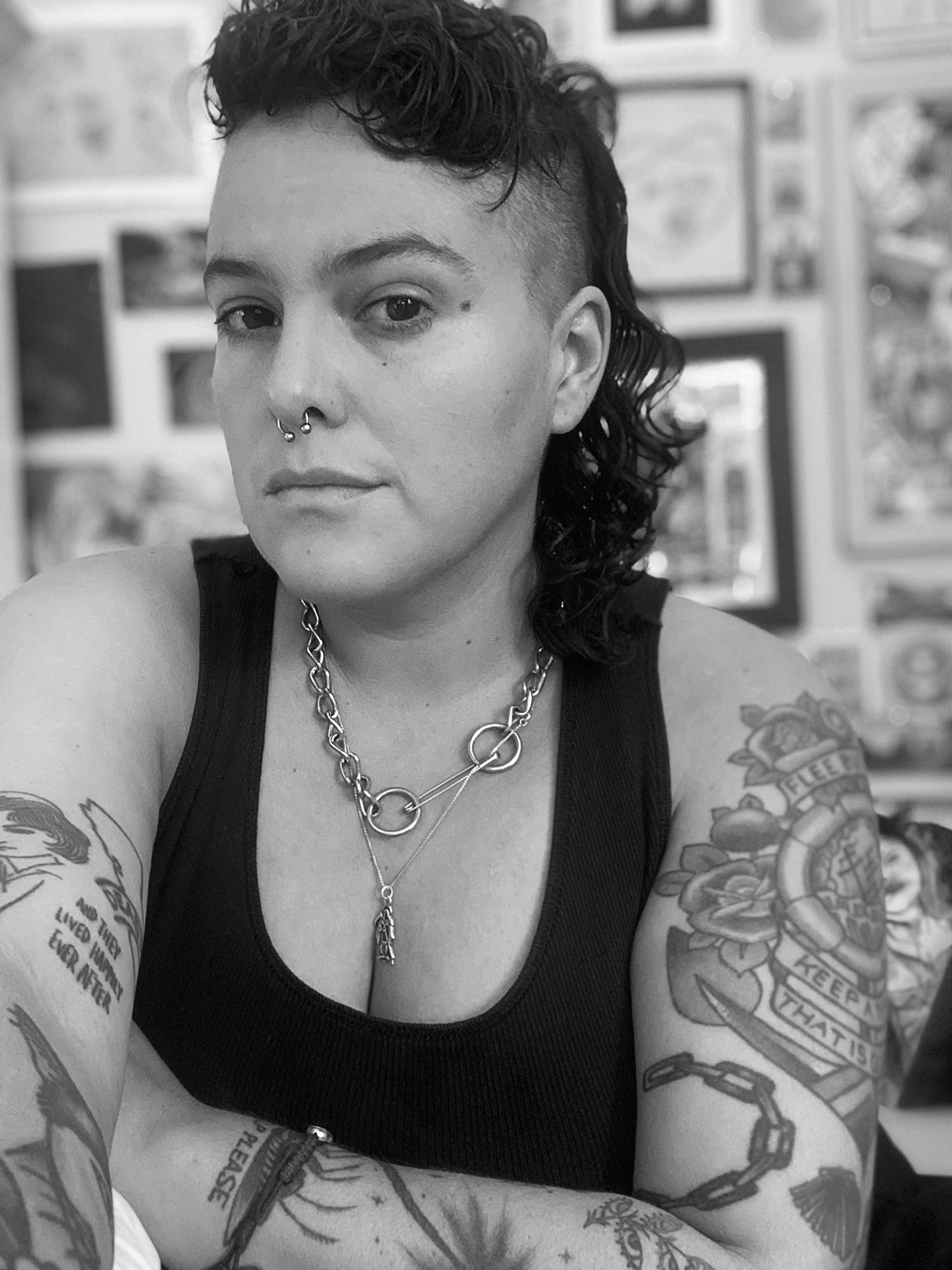
Phoenix Mendoza lives in the woods with her wife where she raises pigeons, buries roadkill, and writes. An unashamed enthusiast of the carnal, compostable, and corporeal, she is wholly dedicated to finding and luxuriating in the junction where beauty and disgust meet to rot together. She can be found on Instagram at bloodinkbonewriting, and her website is https://phoenixvmendoza.squarespace.com/about.
