



SPRING 2026, SHORT STORY, 1800 WORDS
Prefer to read this as an EPUB or PDF?
Join our Patreon and instantly download issue 42:
Some of your mother remained burning in the wick of the candle she had lit for you while you wrung out tattered rags to daub the sweat from her forehead. She had always run too hot, your mother. Her insides were a growling furnace that snapped away at her entrails; all too eager to set her ablaze from within, like an arsonist without an escape plan.
You had been trying to break her fever, you see: It had been dark. You had thought you knew her chambers well enough, having crossed to and fro enough times to wear smooth grooves the length of your stride into the felled-pine baseboards. But you stumbled over something on your way to her sickbed—one of the copper chamber pots cavorting at the foot of her bed, waiting to be vacated, or that blasphemed loose nail in the floorboards, always so perfectly obfuscated by the hay strewn around the room to soak up urine—you don’t quite remember. And she had gone, with her weak voice that crackled like pork rinds over open flame, “Oh, you poor thing. You shouldn’t have to fuss over me in the dim, like this,” and tried to hide her grimace as she turned, oh-so-gingerly, to reach to her bedside. Before you could protest, she rubbed at the blackened, oxidized wick of the candle that squatted on her nightstand with the pads of her fingertips. She motioned over it once, twice; the charred string ignited before a thrice.
Looking back, you should not have left the candle there. It only served to tempt her. A woman with little else to do but gaze upwards and imagine what the sky must look like beyond the canopy of her bed frame had ample time to succumb to temptation. When you chided her for needlessly expending her vigour, she looked at you with those incandescent eyes, the ones that told you she could find nothing to be remiss in this moment. Not the astringence of her soiled sheets; her metastasized bedsores; or even the blaze that grew emboldened within her arteries, each night the fever crept back into her blood. Your mother only mused aloud, caressing the flyaway hairs which leapt from your temples, “How could I possibly hope for grandchildren when you spend the whole of your time pinioned to my bedside?”
You never were able to break the fever.
You awoke the next morning upon your mother’s unbreathing body. You had fallen asleep over her breast, like when you were a babe. Your mother had been cold, like a discarded rag.
In that moment, there was little else you could do but rake your fingernails across her chest. Open! You longed to crawl inside her. How had she simply left you there while you slept? Open up! No utterance of a parting word; no denouement, no warning. You should have felt it. Would have felt it. She was still in there, somewhere, freezing in her own body. Trapped! And she must be so cold. She did always run so very hot, that self-immolating mother of yours.
Tears ran red as they intermingled with blood seeping from the gouges on her collarbone. You were finally broken out of your weeping by a sharp rap sounding from the door.
The physician.
Come for your mother’s weekly checkup, for which you shelled out near the entirety of the household allowance for, unbeknownst to her.
Parts of your mother—lurid pink and crimson parts—were crammed beneath your fingernails when you went to answer the call. You suppose it would have been prudent to scrape your nail beds clean with one of the damp cotton scraps awaiting washing in a pile on the floor, but you really couldn’t quite bring yourself to care as you took encumbered, shambling steps towards the threshold of your home, heaving your weight onto the walls and furniture.
You flung loose the door’s heavy wooden latch and let it swing open to greet the physician. A pillar of black draping robes stood at the precipice. The man within them nearly offered an easy greeting, until his beady gannet eyes darted from your face, to your stained fingertips, back to your sullen visage. The physician balked, staggering backwards. God, he was going to leave. You couldn’t let him. Not with your mother still waiting for you, back in her chambers. He had always been fond of her. When the physician had visited, in those last final days, he would remark how strange it was that she burned so steadfastly, despite her sweet and even temperament. He would stay, for her. Without any further thought past the first impulse, you collapsed to your knees. Buried your head into his robes. Dug your bloodied nails into his dark woollen vestments—felt parts of your mother transferring from you to him as they seeped into the porous fibre.
“Please.”
The physician tugged at the fringe of his tonsure and looked up to the overcast heavens. He huffed out a weary sigh.
“The gashes appear to have been inflicted posthumously, or at the very least don’t appear to be the acute cause of death,” the physician murmured as he undocked his eyepiece from between his brow and cheekbone, disappearing it into the furrows of his robes. He flicked a tentatively exonerating glance to where you knelt, breathing prayers into the livid heel of your mother’s palm. You averted your gaze at the mention of her passing, and pointedly avoided it in your next words.
“How did it happen?”
“How else?” He looked back at the thing he believed to be a corpse. “She was ailing. For a long time indeed. I am sorry for that, but it is over now.” The physician rose, collecting his various implements.
“I shall take my leave now…” He trailed off. Something in your mother caught his eye. He strode across the room, leaned in so close he could kiss her, then swiped a finger under her nose. He drew back quickly at the sight of whatever substrate lay upon it.
Blood?
That would hardly be surprising, would it? Given the amount which surfaced after you rended her apart with your nails. No, he was sifting it through his fingers as you would a talcum powder. It smeared his withered hands like the night.
Ash.
Now that your mother’s head had been disturbed on its axis, more of it fell from her nostrils and dusted her upper lip, in minute black motes. “I suppose a full inspection is in order now,” he declared—an afterthought. The physician was already twisting your mother’s limbs, raising her arms over her supine form, and adjusting her neck in its socket. “Help me turn her over.”
You obliged, each of you grabbing one side of her waist and shoulders. Neither of you boasted any particular strength, but you both heaved. As you did, you’re unsure if you heard it, or moreover felt it, but something inside your mother crumbled. From the seams you had torn into her flesh, your mother’s ribcage unfurled like the plumage of a cygnus. Yet more parts of your mother came thundering from her chest cavity—only, unlike the parts crusted against the backs of your nails, crimson-turned-burnt-umber, what emerged from your mother was midnight in hue.
A plume of ash billowed outwards, coating the unfortunately positioned physician in cremation dust from top to toe. He fell back, legs splayed, hands flying to wrap around his neck. Between labored gasps, he hacked out waves of charcoal clouds. His mouth had been open during your mother’s grim blossoming. You rushed round the bed to help him to his feet, but he threw an arm out to enforce space between you and him. The physician collapsed onto all fours and emitted a guttural curdle of a scream, flinging black-stained spittle onto the hay strewn upon the floorboards. You could do little else but stare slack-jawed as he clambered to his feet like a wraith, retreating expeditiously to the door.
With the physician gone, you turned back to assess the bursting form of your mother. It is clear now: you had been wrong. Your mother no longer resided within her cold body. Her soul—or some other intangible ember within her that made sparks jump out from the surface-nearing veins at her wrist—had burned clean through her body. Now, with it flayed wide open, you could see it: the charred edifices of her bones, her heart, her lungs, her liver. Her mind, although nestled in the crook of her skull, had doubtlessly caught aflame too.
Your mother had lived her life burning from the inside out.
Still, though. You were reared to have unfaltering trust in your good senses; your intuition. You knew you had heard your mother keening for you while you dug into her chest like a scent-driven beast. A waning movement in your periphery ensnared your attention.
Some of your mother remained burning in the wick of the candle she had lit for you, while you wrung out tattered rags to daub the sweat from her forehead. It was only the thickness of a shilling, barely a pool of wax now, after having burned through the night. A small flame still nipped away at the little remainder of wick, unextinguished despite the laminar flow of ash whose sheer force ought to have expunged it in an instant. Nevertheless, a part of your mother remained waiting for you on her nightstand.
Oh-so-gingerly, you cupped the minuscule flame in your palm, shielding it from any interfering air current. You glanced around, searching for fuel. The tawny linen canopy of your mother’s bed frame seemed suitable enough. As with a suckling babe, you slowly lifted your mother to meet the fabric overhang. She leapt from her bassinet of melted tallow and spread herself jovially along the canopy. She grew, hot and healthy, across the length of her bed frame. Once she’d sufficiently had her fill, distinct forms began to emerge from the blaze—a flicking hand here; a nose there. Then suddenly, as though she had never left, there your mother stood: a tall blaze in the centre of the room. Shadows danced around her, ecstatic, just like how you remembered she used to make them move when you were a child, before she’d lost the strength. She spread her arms wide, and motioned for you once; twice, and your heart soared; you flung yourself headlong into your mother’s embrace before a thrice.

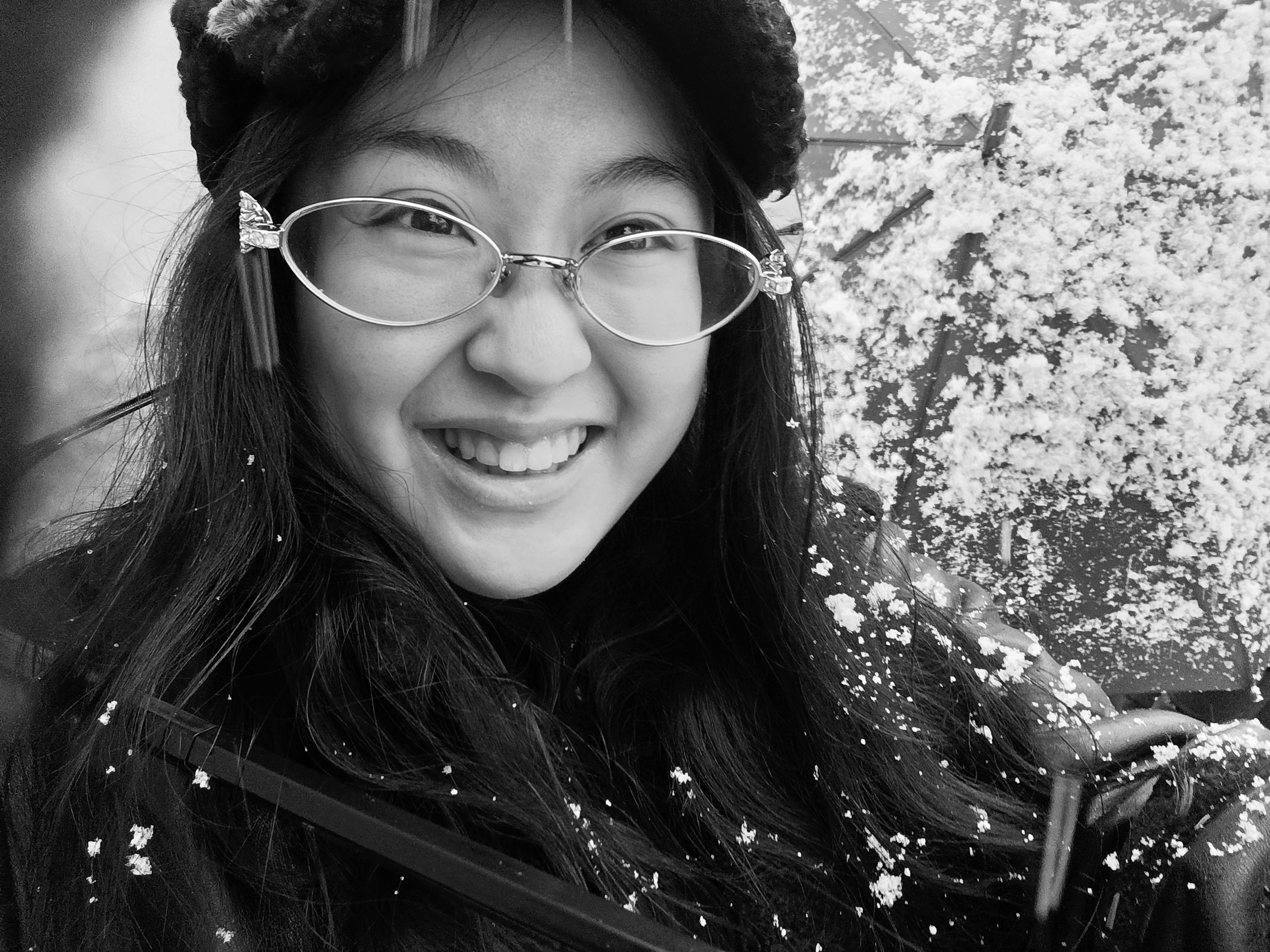
Maya Y. Ng is a student at the University of British Columbia, pursuing a bachelors in Environmental Studies with a minor in Creative Writing. She is a film camp instructor, where she delights crafting bizarre and incredible short films with her even more bizarre and incredible students. In her work, which usually manifests as some form of fantasy or slipstream, she seeks to capture those “full-circle” moments that make life feel whole—she’s always hunting down stories which take audiences on wild, transcendent journeys. Maya’s work has appeared in journals such as The Starfish and Ariadne, as well as indie film festivals such as Lil Spooky Fest.
