



SUMMER 2026, SHORT STORY, 2400 WORDS
Prefer to read this as an EPUB or PDF?
Join our Patreon and instantly download issue 43:
When Deehah, my grandmother, dies, I decide that I will take her eyeballs before the family swoops in.
Her body lies in a casket, silver-grey hair framing her beautiful, serene face. When Deehah lived, she was one of a kind. She was a phenomenal and beloved superhero who went by the name Shadow Shields (even though her given name was Lakshmi Narayanan). She would lift buildings that housed terrorists and deposit them right in front of the police stations, she would divert rivers by swallowing water to prevent floods, carry ambulances on her shoulders, and ensure patients reached hospitals quickly in peak traffic. The world was her playground, and she would toy with her superpowers to her heart’s content.
But for me, she was also Deehah, my grandmother, under whose cape I would hide as a child when the thunderstorms roared ravenously. She was my Deehah, my grandmother, who carried my cousin Kadambar on her shoulders until my mother shuddered while Kadambar cackled with a mischievous impunity of missing school. She was my Deehah, who put my little cousin Kavya to sleep every night by singing her lullabies. She was my grandmother, but I was forced to share her with the world and everyone else.
“What are you doing, Devi?” my mother asks when she spots me suspiciously close to the casket.
“Nothing, Maa, was just brushing off the flower petals from Deehah’s forehead.” I lie, but there is a modicum of truth in my words; her mourners had filled the casket with flowers. They have been here all morning, wailing and beating their chests, sounding like trucks with punctured wheels on grated roads.
By evening, my mother and her brothers had had enough of cacophony. They close the door, draw the curtains, apologise to the hordes of mourners waiting outside, and finally settle in for dinner.
“Definitely not a burial, Chutki, we don’t know what chemicals may leach,” Ved Mama says, licking the undersides of his teeth, chewing the soft skin on chicken while ladling biryani on his plate.
The biryani comes from the most famous biryani shop in our city. Deehah had lifted a buffalo that had entered the shop, entranced by the aroma of the spices in the biryani. That it wasn’t for buffalo consumption, he hadn’t realised. He had charged straightaway, uprooting customers, knocking off handis placed neatly on the counter while helping himself to spice-laden rice. The pieces of meat he had left aside. When Deehah had entered the shop, she and the buffalo had a standoff at first, but Deehah was persistent. She lifted the unsuspecting bovine with one hand, flew away, and deposited it far away in a field. The shopkeeper was ever so grateful, and we got free biryani for the whole family on every New Year’s Day. When the shopkeeper heard of Deehah’s demise, he brought handis and handis worth of biryani.
But such stories matter only to us, the third generation.
Where my cousins and I ooh and aah over every minute detail, Ved Mama doesn’t care for any of Deehah’s stories of bravery; they have all become commonplace, like yesterday’s cooked rice for him. Details blur, the people he doesn’t remember, and whether she used lasers or super speed aren’t of interest to him. As long as Deehah emerges as the saviour in each of them, and he gets something in return, he’s fine with it.

It is later at night, and we three cousins (Kavya, Kadambar, and I, Devi) hide behind the door when the adults discuss Deehah’s funeral arrangements. Technically, I am an adult too (one in the second year of college), but I am kept out of the discussion.
“Well, we should think of a casket instead. She was a superhero, and people would like to pay homage to her.” Pankhur Mama is the middle child and a decorated IPS officer. Deehah had hoped that one of her children would inherit one of her powers. He showed the most potential, but fate had other ideas.
“All that is fine, Bhaiyaji, but we should keep her body parts. It is the least that we can do to ensure our family’s legacy. There hasn’t been one like Deehah in centuries, and we don’t want our family to decline, do we?” This is Rakhi Mami speaking. She is married to Ved Mama and shares his capricious sensibilities.
“No, Bhabhi, we cannot desecrate my mother this way…” I know this pleasant and reasonable voice to be my mother’s. She was the closest to Deehah, taking care of her year after year as she declined.
I can hear Ved Mama again as Kavya’s foot squishes mine. I hold the urge to scream.
“Sheetal, it is not desecration in the least. We must keep some of her superpowers in the family. It is the only rational and logical thing to do. None of us inherited her superpowers. We should think carefully about our bloodline.”
“Devi, Kavya, and Kadambar are all young. You should think about their future.” I reckon this is Vani Mami, married to Pankhur Mama, Kadambar’s mother. She takes great pride in announcing to everyone that she has borne a son, unlike others, who have borne daughters.
The hierarchy is muddled in one sense in our generation. I, Devi, am the eldest and come from my mother, the youngest in the previous generation. Kavya is Ved Mama and Rakhi Mami’s daughter, the youngest in our generation, but doesn’t share their greedy nature. She is sweet and kind as they come. Only Kadambar has held on to the mantle, the middle child of the middle child of Pankhur Mama and Vani Mami.
We listen to the adults, go back and forth, and then sneak back to my bedroom.
“I would want a part of Deehah, preferably her heart. My teacher said she had a big heart and was a beautiful person,” Kavya whispers to us as soon as we enter my bedroom.
“How do you propose we do that without surgically slicing up her body, dummy?” Kadambar adjusts the spectacles that droop in laziness over his large nose. What he lacks in empathy, he makes up for in brains.
“I would go with her cerebellum and medulla oblongata, kept in formalin in my room. What would you choose, Devi Didi?” Kadambar gazes at me through his spectacles again, expecting an answer.
He looks bug-like and creepy. He would often compete with Deehah on sudoku and complex math problems. Her brain chemistry had altered so much that it could outrun ten thousand supercomputers with ease.
Kadambar lost every time.
I avoid the question and tap Kavya’s left clavicle. “She is in here already. What will you do with her heart?”
Yet now, hearing the adults talk about Deehah’s body as if she never existed as a person makes me rethink my earlier longing. Sure, Deehah’s eyes could emit lasers when she wanted, and that was cool, and she could slice vegetables perfectly, but that wasn’t why I wanted Deehah’s eyes.
Deehah could see everything: the pain of a child losing their first shoe, a broken table that needed repairs, a person who had lost everything and was sitting precariously on a tenth-story balcony, and even a bride who cowered from her in-laws. Deehah saw what everyone overlooked, through the cracked rivulets of pain that people missed in their passion for the humdrum of life.
But I understand the longing and resentment that my family has. Six direct members, and not one inherited her powers. There would be no brinjal curry with perfect Fibonacci curls anymore, no free food, no favours from unsuspecting people, no police escorts, no special holiday vacations or photographs plastered in newspapers. The list goes on and on. There is much that the family is set to lose from Deehah’s demise—an inevitable but imminent obscurity.
It is the next day, and still no decision has been made about Deehah’s funeral. Should there be a cremation, since we are Hindus? Should we bury her (some Hindus do that, too)? Should we turn her over to a compost company so she can be returned to the earth like the proverbial goddess Sita? Should her body be laid out in a casket like a saint to be watched over by the family?
There are debates, and more debates. They turn her body over a thousand times to unlock any secrets that may have been missed earlier. They comb her hair and try to power a generator to see if her powers lie in her hair like Samson’s; it works. They make water touch her fingers, freezing it. They place an egg over her chest, and it becomes a chicken. Deehah is still magical and powerful all over, but they also surmise that her magic is contained only within her body.
Help soon arrives in the form of an attorney.
“I am Debjeet Roy, executor of Superhero Shadow Shields, aka Mrs. Lakshmi Narayanan’s will,” he announces proudly.
“We will start. Organs of the deceased will need to be removed and handed over to the following people. Kavya Mishri Narayanan, my beloved granddaughter, will get my heart. I leave my entire brain to my smart and resourceful Kadambar Divyam Narayanan. To my kind eldest granddaughter, Devi Suresh Mishra, I leave my eyes. Each of the three grandchildren is assured a sum of twenty lakhs, which they can withdraw at age twenty-one.” The lawyer pauses and then drones about the rest.
I feel shame and sadness as I listen to him list more assets and their distribution. The house goes to my mother, even though Ved Mama grumbles a little. He is given a new home nearby, and he and Pankhur Mama are compensated handsomely. Deehah has only one request: to be treated with mercury, and for the back portion of our house to be a memorial for those who wish to honour her.
We take Deehah’s body to the hospital the next day. I feel like a zombie sitting outside the operating theatre. They wheel Deehah’s body covered in a white sheet, and once over, they all hand us different organs.
Days pass in a whirl, and I learn how everyone uses their organs. Rakhi Mami gets her reproductive parts and starts a cult of fertility. Childless couples throng to her from far and wide to get their wishes granted. She also offers tarot readings and astrological birth charts to determine if your child will inherit superhero traits. Many twins and triplets are born before Deehah’s power starts running out. She takes fewer clients afterwards, only those who can afford her services.
Pankhur Mama gets transferred and sells Deehah’s lungs to the capital city of Delhi. For the first time in many years, the AQI falls to 1, and the people rejoice. Kadambar finally tops his engineering entrance exams and clears the IIT prelims. He spends all his time in the coaching classes and never comes home. Still, his mother is proud.
Deehah’s liver, stomach, and kidneys remain in the family altar that Ved Mama got constructed at our house instead of his. My mother is the most conscientious. Spooked at the speed with which Rakhi Mami’s business endeavours drained us of Deehah’s powers, the family decides to be frugal. The organs are brought out only for special occasions and viewings.
With our family trunk disappearing, we are like a rusted bicycle held together by a corroding copper wire. The dishes don’t get done on time, the vegetables lose their tartness, cheques bounce, and the house crumbles under fatigue and moroseness, but we try to keep it together. I don’t bother to look at my inheritance. I buy a new fridge, place it next to our old fridge, and put Deehah’s eyeballs in the freezer. I know Kavya refuses to see Deehah’s heart. She gives it to my mother for Deehah’s museum, which is placed next to Deehah’s body, shrouded with a cloth.
Kavya and I sit outside our house every weekend. Mumma built a museum for Deehah. Papa comes home and helps her. The building where he used to work was flooded in Doha, and his flight couldn’t take off. He finally resigned from his job abroad.
People still throng to catch one last glimpse of their favourite superhero. Word has already spread about her reproductive organs losing power. Who knows how all her inheritance will finally absolve itself of all power?
Kavya and I sit outside the house, watching the mourners file in. It is my last summer before I go off to my final year in college, and she clings to me every day, hoping that I won’t disappear like Kadambar, leaving her alone.
“I anyway get to see you so little, Devi Didi,” she tells me daily.
We sit on the porch from the museum’s opening time, watching the mourners line up till evening. They come in all shapes and sizes. Some carry mangoes and gooseberries, some have flowers, some leave pebbles, hoping they will absorb Deehah’s powers.
A mourner mistakenly finds his way to our porch and, upon seeing us, asks for a glass of chilled water for the hot summer day. Kavya and I get up, and she shudders when she sees the remnants of Deehah’s body kept high up in the altar, smelling like formalin. She covers her eyes with her hands and stumbles to the fridge where Deehah’s eyeballs are kept.
“Are those Deehah’s?” Her lower lip quivers.
“We can use the other one, Kavya. Let it be.” I tell her.
She perches on her tiptoes and opens the freezer section of the fridge. It takes us a moment to realise it is empty. There are no bottles to keep the water cold, no ice cubes, no stalagmites and stalactites lining the freezer.
Kavya bursts into tears.
“I wish we had kept Deehah’s soft hands. I have no grandmother to talk to me anymore. Who will fill the ice cubes now?” Kavya cries with a passion.
She runs outside the gate onto the road, where she can’t go without an adult.
I dash right past the surprised mourner with a protective maternal instinct guiding me. My naked feet surge with a surprising, ungodly superpower.

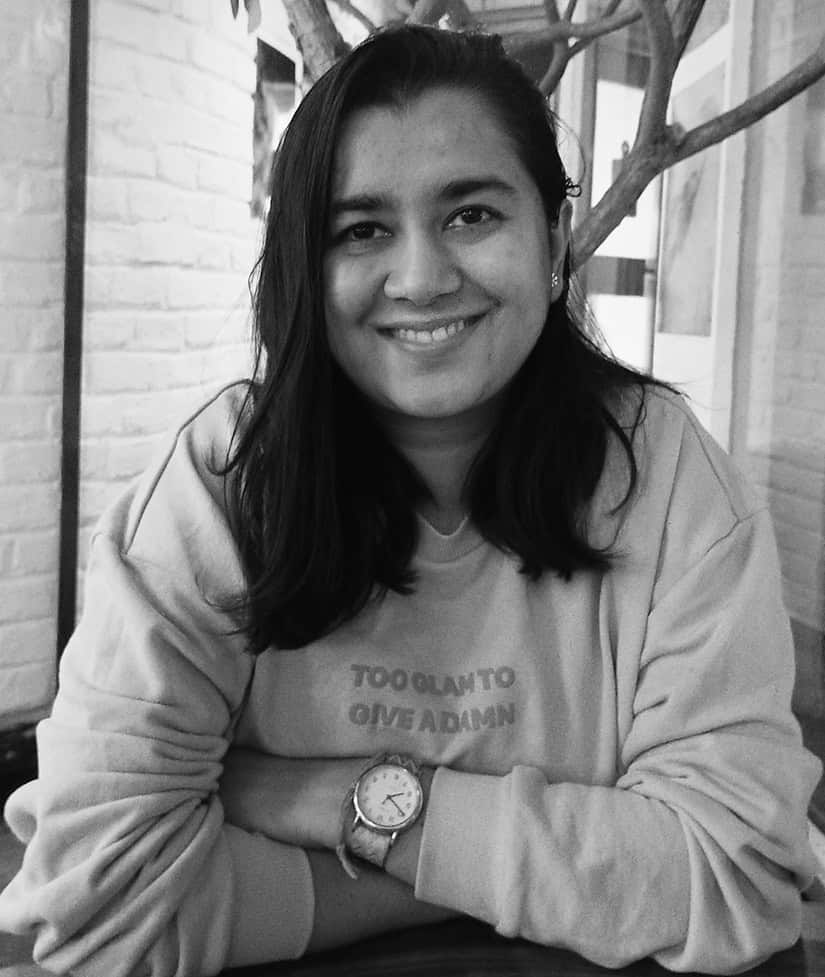
Shobhita Narayan is a writer, marketer, and artist. She was the runner-up for Reader’s Digest Asia 100-word short story award (2013). Her fantasy debut for children, Midaash and Maitreyi’s Magical Mayhem, won the Best Author Award 2025 by PVLF (India). Her short fiction has been published in Bangalore Literature Review, Tasavvur, and Between Worlds (Westland Books)and a short story is slated for Bare Bones Publishing’s forthcoming speculative fiction anthology. When not immersed in books and writing, she enjoys anime, fantasy and sci-fi shows and movies.

