
Who do you see as your literary heroes, and why?
In terms of writing style, I love Mary Shelley and Jane Austen—I like the cadence of tone of 19th-century language, the different way of storytelling in that era vs. the way novels are now. In terms of world building and how it’s revealed to the reader, I love Ursula Le Guin and Octavia Butler. In terms of dragon stuff, I love Anne McCaffrey and Naomi Novik. In terms of message and philosophy (and also worldbuilding), I love Terry Pratchett.
To Shape a Dragon’s Breath got a lot of attention, including winning you the Astounding and Lodestar awards! You also published a book in 2020 but I suspect you’ve been writing since before then. In fact, your publisher bio says you’ve been writing since age twelve, but writing is not the same as “trying to get published.” Tell us a bit about your journey in publishing. Have there been highs and lows; have there been frustrations and struggles; or has it been pretty smooth sailing, as soon as you decided to try to get work published?
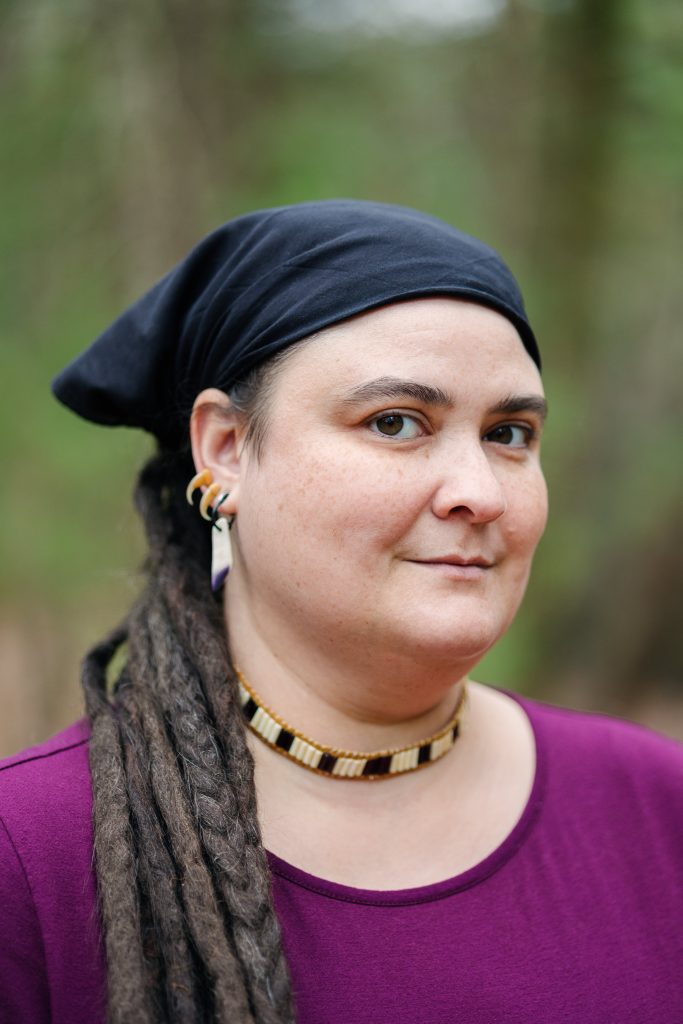
For me it’s been pretty smooth sailing; I spent a lot of time finding the right fit for an agency and fielded a lot of rejections during that process, but I expected that and wasn’t put off by the time and effort it took. Once I’d found them (shout-out to Prentis Literary!) It was mostly waiting patiently on my part for my agency team to find a publisher. I’ve been studying the process of publishing since I was thirteen or fourteen, and I’ve published short stories, but To Shape a Dragon’s Breath was my first traditionally published work with a print run.
To Shape a Dragon’s Breath came out in 2023, and book two of Nampeshiweisit,To Ride a Rising Storm, is scheduled to publish soon! What was the process of writing the second book like, especially as compared to book one?
Writing a sequel is definitely the biggest writing challenge I’ve ever set for myself, and writing the third book of the trilogy is proving just as tricky—to the point that I’ve decided that from now on I’m going to write self-contained novels or not release the beginning of a series until the whole thing is entirely complete. Deadlines, as it turns out, make it way harder for me to get into flow state and make the writing process more difficult. Being unable to go back and change minor details like train and ferry schedules, or street names, or days of the week is far more of a hindrance than I’ve previously considered with projects that are released entire. I’ve learned a lot from this process, primarily that I don’t want to do it like this again!
In your Locus interview you talked about doing research for creating your dragons, and being very deliberate about creating dragons that were different from the way dragons are often depicted. Are there things about To Shape a Dragon’s Breath that people don’t seem to notice as much that you’d love for them to see; or that have been misinterpreted or misunderstood; or just things that you would otherwise like folks to know?
I want people to take from this book whatever they want to take from it; I largely stay out of reviewer spaces because those are for readers, not authors. Of people who’ve approached me directly to talk about my work, I can’t say that there’s anything in particular that readers don’t seem to notice as much as I’d love for them to notice—I’m happy when people are excited about whatever particular details excite them. Also, I love fan art, even when it doesn’t match the image that I have in my head.
How would you describe the main character, Anequs—what is she like, what do you love most about her, and where does her journey go in To Ride a Rising Storm?
Anequs is very grounded in her identity and culture; she’s curious, driven, and stubborn. She’s resistant to Anglish attempts to “civilize” her because she knows that there is nothing wrong with her civilization (and is willing and able to point out things that are wrong in Anglish society). She’s dedicated to fairness and justice, and wants these things for everyone, not just for herself. She has low tolerance for anything that she considers nonsense, which has both good and bad aspects.
As to where her journey takes her, the answer is “into a lot of trouble” because evil always triumphs in the middle of the story (hat tip Rich Burlew for that line)—in To Ride a Rising Storm we see the impact that her year at school and increased scrutiny from Anglish colonizers has had on her community, and how the Anglish at large are responding to increased knowledge of the people on the islands. We see what it means to have people in power paying attention in a way that they weren’t before—people who have marked her people and her specifically as an enemy other who needs to be subdued or destroyed.
The Grimdark review of To Shape a Dragon’s Breath praises, among other things, your “fully realized” characters as well as the way they are utilized throughout the narrative. In terms of craft, what is your approach to developing characters, and how does this approach change or transform in To Ride a Rising Storm?
If a character is important enough to the narrative to get a name, that means that in my world they’re a whole person with their own experiences, thoughts, feelings, agendas, etc. I introduce characters to the story to fulfill narrative needs, and then determine what kind of person would do the kind of thing that I need them to do in the story—what would their life look like up to that point, what would have led them to the action they’re taking. This is my approach across all of my writing—it hasn’t changed between To Shape a Dragon’s Breath and To Ride a Rising Storm.
What, for you, is important or central about To Shape a Dragon’s Breath, and do the same things stand as central in To Ride a Rising Storm? Or does the conversation and heart of the story shift, and if so, in what direction?
The most central message of the Nampeshiweisit series is that different cultures have wildly different philosophies and ways of being in the world, and that my narrative centers the (northeast coastal woodland) Indigenous worldview/lifeway.
What is your relationship to fantasy as a genre like, what does fantasy do that is interesting or special, and how does this show up or weave through these books?
I’m a huge fan of speculative fiction, both fantasy and sci-fi—and I believe that there’s significant overlap between those genres; it’s not always easy to determine what’s fantasy and what’s sci-fi and what’s both. I like fiction that asks “what if,” both as a reader and as an author.
The Nampeshiweisit series is, like McCaffrey’s Pern books, firmly shelved as “fantasy” because it’s got dragons and magic in it, but I’d argue that it could (and in the 19th century among peers like Mary Shelley and Jules Verne) be classed as “science fiction”; as an author I certainly know all the scientific underpinnings of what’s happening, even though the characters do not because the scientific revolution in their world is only just starting. To quote Arthur C. Clarke, “Any sufficiently advanced technology is indistinguishable from magic”—the characters cite magic quite often, but what is literally happening is very rooted in the laws of physics. Chemistry, in this world, has been misidentified as supernatural.

Moniquill Blackgoose is the bestselling author of To Shape a Dragon’s Breath, which has won both the Nebula and Lodestar Awards. She began writing science fiction and fantasy when she was twelve and hasn’t stopped writing since. She is an enrolled member of the Seaconke Wampanoag Tribe and a lineal descendant of Ousamequin Massasoit. She is an avid costumer and an active member of the steampunk community. She has blogged, essayed, and discussed extensively across many platforms the depictions of Indigenous and Indigenous-coded characters in sci-fi and fantasy.