
JUNE 2025, FLASH, 1600 WORDS
Prefer to read this as an EPUB or PDF?
Subscribe to Fantasy to support short fiction, and get every story as it drops:
You weren’t born to be a black hole, though sometimes you would think of your mother and wonder. She collapsed in on herself when you were 9—took your home and your childhood with her. Your father was driving you to school when the local stellar corpse alert came in. You still remember the sharp U-turn, the bitter stink of burnt rubber.
Later, your father asked if the loss was a pit in your stomach. You said no. The loss felt deeper than that, like someone scooped out your insides and was still scraping, metal on bone, bone to gut. You opened your mouth to tell him, but he was crying, and your teeth clicked shut, the words sliding back down the back of your throat. Silence crept between your teeth, but still, you kept swallowing so you wouldn’t cry, and the silence settled in your gut. You didn’t know back then, but the secret was this; black holes start with swallowed silence.

You started standing straighter to hide the hollowness of your architecture. You used to think you’d grow around it, out of it, but nine turned to twelve turned to seventeen, and still, the hollowness grew with you. Sometimes your father looked like he might say something about the way you held yourself, and you wondered if the hollowness lingered because he never did. You tried to fill the ache with friends who thrived in the presence of your attention-starved silence, filling the time with quadratic equations, Shakespeare, and all the other miniscule things your school taught you to care about.
After class, a teacher asked you to clean the board, and you said yes because in those days you said yes to everyone except your father. You erased equations like constellations. The chalk settled on your wrinkled fingertips like moon dust, and your gut pulled. No one was looking. You licked the dust off your fingers and swallowed.
When you turned eighteen, you sat alone in the kitchen at dawn, a birthday card, and a new notebook from your father already on the table. You preferred early mornings, when the quiet was too gentle to be lonely and the coffee was a warm clarity. Your birthday always grated at you, and on this particular birthday, your coffee sat beside you, lukewarm and untouched.
You ignored the notebook, crumpled the birthday card, and threw it in the trash, then pulled out the only photograph of your mother that your father did not hide. Maybe he forgot, or maybe leaving it out was his way of being kind. You wanted to ask him about it, but you didn’t know how to ask him anything, and both of you spent your teenage years learning the language of silence.
In the picture, your mother was laughing at the beach, her hair still wet from a dip in the ocean, and your father was smiling at her, squinting eyes like he was looking at the sun. In the picture, you sat between them, but the fold in the paper cut through your features. You couldn’t remember what you looked like happy.
You stared at your mother. You stared at yourself. Your gut pulled with wanting. You folded the photo. You eclipsed yourself. You eclipsed your parents’ joy, then you folded the picture over and over again until it was a sharp star-point. You lifted it to your mouth, and let the joy-eclipsed picture sit on your tongue. You imagined what your father would say if he caught you. You imagined what you would say to him. You swallowed the picture whole.
After the picture, you swallowed:
The bitter ashes in your father’s cigarette tray.
The rose-scented puff from your mother’s old compact.
The budget perfume samplers your father gave you every Christmas.
The rhinestone-lined friendship bracelet your best friend made for someone else.
A love letter lined with heart-shaped push pins tacked onto a café bulletin board.
A phone in the food court lit up with a text from someone checking in.
Daffodils in the children’s park.
Gravel in front of a laughter-filled home.
Your hair–a month later, when it began to fall out.
You shrunk into yourself, bones compacting, extremities curling. Every day, you rolled up your shirt sleeves, and the hem of your jeans. You sucked on your peeling cracked lips, and tasted your family’s blood.
Your father almost asked, the words teetering on his tongue. You could tell because he looked at you the way he did when you were nine, like he couldn’t tell if he was afraid for you or of you. You wanted him to ask. Then you wanted to ask him how to fix this—fix you, because you didn’t want to collapse. You didn’t want to be a black hole. But you didn’t know how not to. He opened his mouth, and you thought: this is it.
Instead, he sighed, until he deflated under the kitchen lights. He wouldn’t meet your eyes again, and any plea you would have made for his help died on your tongue. You swallowed.
Some people, he said finally, were born to be black holes.
Later that night, you received a local stellar corpse alert. Then, a phone call.
Your father turned into a black hole on the beach. Suddenly, you were nine again, your father asking you if the loss felt like a pit in your stomach, and you wished you could tell him that loss was all you felt. But he wasn’t here to ask, and you sobbed because he would never be here again.
In the morning, you walked to the beach, and you stood where he had stood, and you imagined him swallowing all the things he wanted to tell you. Your mouth crowded with everything you should have told him. You vomited like it could bring back every word, every memory you ever swallowed, like that picture all those weeks ago. Your knees buckled. The hollowness in your gut ached. You imagined you could see your father’s footprints, and you ate the sand and seaweed, ocean-sour.
You wondered how much of him you had missed in the years after your mother’s collapse. You used to think you understood him, even if you couldn’t forgive him. You hated that now you never would. On your father’s birthday, you looked in the mirror and found your navel sunken into your spine. You wanted to say something to someone, but you didn’t know who or what, and you certainly didn’t know how. So, instead, you swallowed your father’s only good shirt and his favorite mug.
It took a year after you lost your father before you finally worked up the courage to go through his things. In his closet, you found a shoebox full of the family pictures he’d hidden. You looked at each of them once, then you swallowed the pictures, box and all, before you realized what you were doing. You cried until your spine curled around regret, your body wrapping itself around the shape of absence, forehead to knee, skin to tile. Your bones cracked, and the air around you shimmered. Every breath sucked in seconds, minutes, hours. Soon, there would be no light that could escape the gaping mouth of your grief. With the cold ceramic pressed to your cheek, you thought: this is how I become a black hole.
But you didn’t want to be, I don’t want to be, and though you were so full of loneliness you were choking, when everything else was stripped away, the one truth that remained was this: you still wanted to be here. Your father’s closet was full of clothes that smelled like him, and you were the only living person who still knew that daffodils were your mother’s favorite flowers, and you just bought a new blend of coffee you were excited to try, and maybe that last one shouldn’t matter as much, but it felt like it did too.
You weren’t born to be a black hole, and you screamed those words as a mantra over and over even as each gasping breath began to swallow the sound of your voice. Lifetimes passed, and finally, you felt the truth of yourself settle inside you. You weren’t born to be a black hole, and you wanted to be here—neither of those things erased the things that hurt, but bit by bit, your bones unfurled back into the shape of you.
The secret was this: black holes start with swallowed silence, so you tried—you try to give shape to everything you have lost, to articulate that aching quiet.
So you write. You are writing. Kitchen table, early morning, defined by the things you need to say, scribbled in the lined pages of the last gift your father will ever give you. Because writing is easier than speaking, though someday you will get there too. For now, you need the physicality of the words to ground you. The act feels like a kind of explosion, even if sometimes you forget that you are still in the present tense.
Later, you will want to swallow this. You want to swallow it, even now. But you cannot let this paper crumple, and you cannot let yourself collapse. Tomorrow, there will be more words because you have more stories than this pain, even if you can’t remember them now. You need to be here to write them. Joy also deserves form.
You were born from black holes. You are your family’s blood. But today, you do not choose silence. Today, the coffee is good.

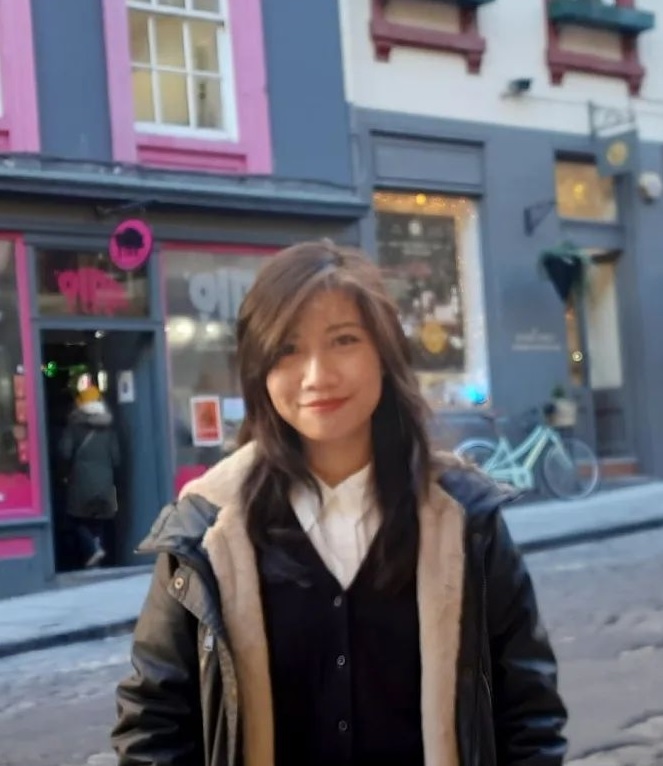
Sydney Paige Guerrero teaches at the University of the Philippines, Diliman and co-edited Mapping New Stars: A Sourcebook on Philippine Speculative Fiction. She won the Nick Joaquin Literary Award for Fiction in 2018 and 2019, and her work has appeared in Daily Science Fiction, Apex Magazine, Cast of Wonders, and other venues. In 2024, she attended the Clarion Science Fiction and Fantasy Writers’ Workshop as that year’s George RR Martin Sense of Wonder scholar. You can find out more about her at www.sydneypaigeguerrero.wordpress.com.
Return to Issue #97 | Subscribe to Fantasy
Behind the Scenes with Sydney Paige Guerrero
What was the initial inspiration for this story, and were there significant changes from that inspiration through edits and revisions?
During Week 2 at the Clarion workshop, Jeff Ford asked us to write a story that was exactly 1,000 words. I was initially planning something completely different, but when I took a walk on the beach with my classmates, there was some really stinky seaweed. The smell was so strong that I could almost taste it, and I kept thinking about the Filipino word “malansa” and how that would translate into English. The phrase “ocean-sour” popped into my head, and I knew instantly that I really wanted to use it. I also couldn’t shake the image of a girl kneeling in the sand, scarfing down stinky seaweed by the handful, and the story developed around figuring out what would drive someone do that. The idea of feeling like a black hole is very personal to me, and I had been wanting to write a story about a black hole girl for a few years now. Through the drafting process, these two concepts came together pretty naturally. The story’s earliest iteration was entitled “Stellar Corpses,” but a classmate pointed out that most people would think the phrase meant “Really Cool Dead Bodies” instead of another term for black holes. I love really cool dead bodies, but even I had to admit it didn’t fit the vibe for this one.
How does this story fit into your body of work—is it similar in ways to what you usually write or is it very different?
It wasn’t a conscious choice, but looking back at my earlier work, I wrote a lot about silence and repression, and in some ways, I feel like this story is a culmination of that. I don’t always have happy or optimistic endings, but it felt important to have one here.