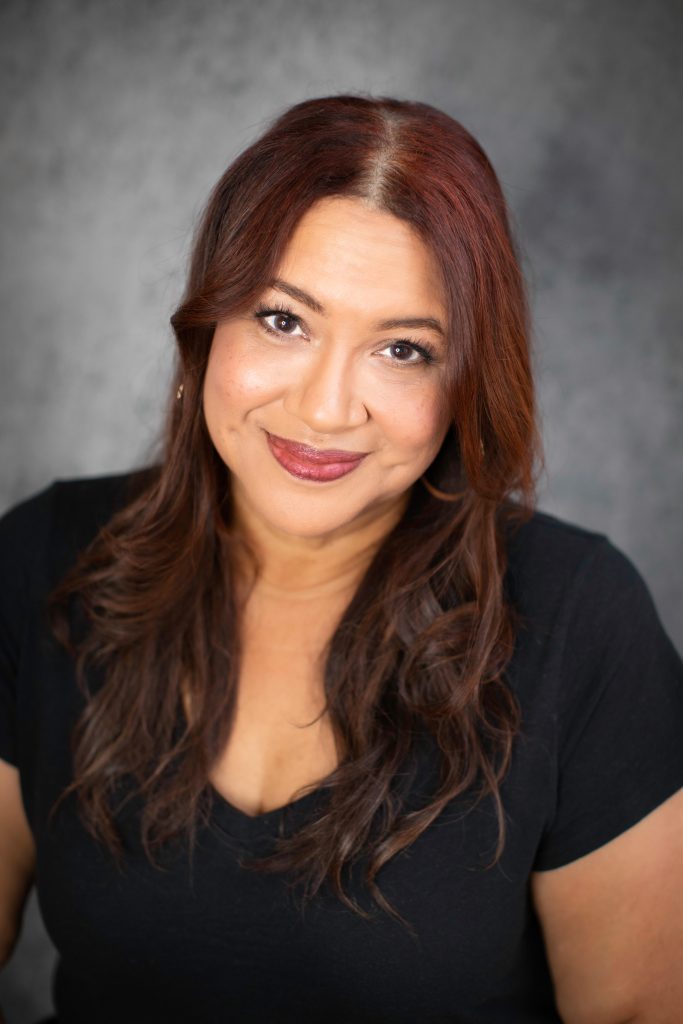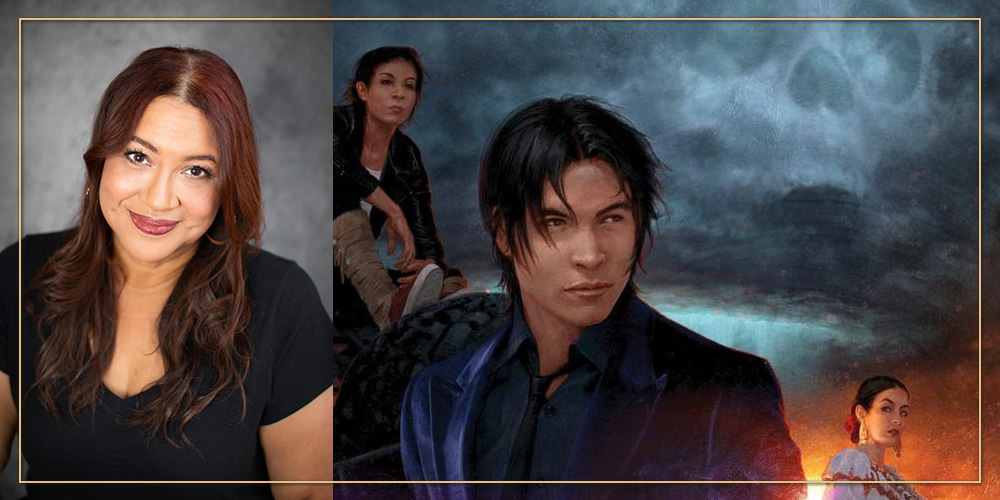
Shingai Njeri Kagunda sat down with author Rebecca Roanhorse, and while this interview was planned for issue #100 of Fantasy Magazine, that did not come to pass. By the miracle of the internet, here it is for you, dear reader. —ECT

Shingai Njeri Kagunda: Hello Rebecca, it is such a delight to be engaging with you and your creative process in this way. I have had the privilege of reading your upcoming collection of short stories, River of Bones and Other Stories, and I would love to know what putting together this collection of short stories has shifted inside of you?
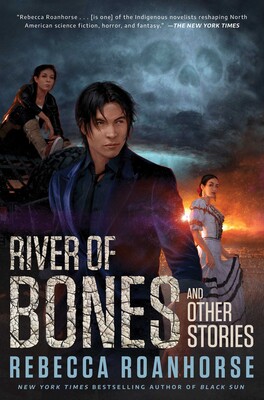
Rebecca Roanhorse: I don’t know that it’s shifting anything inside me, but it definitely feels like the end of a particular era in my writing life. It’s been gratifying to be able to look back at the last almost decade and see my short fiction collected in one place. Some of these stories only exist in e-books or on websites, so it’s cool to seem them in print.
SNK: “Welcome to Your Authentic Indian ExperienceTM” may be one of your most well-known shorter works, appearing as the first story in this collection. That said, it is incredible to see how the tone of the collection reads as so wide-ranging. At what point in the process of writing a story do you realize you have decided on a voice or tone that feels right for that particular story?
RR: Usually from the beginning. Short stories tend to come to me fully formed, unlike novels which are a process and often require extensive revision. Shorts are really my chance to explore an idea or a voice or even an event in the popular consciousness without a lot of overhead and commitment. I usually know who and what they are from the beginning.
SNK: In a previous Clarkesworld Magazine interview with Arley Sorg you spoke to character being one of the most important elements of story for you. Is there an aha moment when you realize you have written a well-rounded complex character? Does that aha moment feel different when moving between short stories and novels?
RR: In novels, characters need depth and a relevant arc—they need to grow and fail and arrive somewhere different from where they began. Shorts, for me, need that much less. They need to exist in their moment and function to tell the story I’m trying to tell. I’m always concerned with character, but not as concerned in shorts.
SNK: Vengeance as an idea comes up in such interesting ways throughout this collection, whether it be about avenging settler colonial theft of life, or taking life in order to satisfy the one you love (Shout out to the deer woman). In our present reality, there is often a narrative that names the people who are resisting apathy, the aggressors or the disturbers of peace; how do you navigate writing violence from the perspective of the oppressed?
RR: I don’t really write violence for spectacle, although I’m also not wholly against it. I am a big fan of the John Wick franchise and I’ve written a Predator comic. But I do try to ground my violence in purpose, and I try to be very aware of who commits the violence and against whom violence is committed. It is another element of story craft that is important to balance. It’s also worthwhile to note that not all violence is physical—there is emotional and social violence that can be just as devastating and effective.
SNK: In that vein, you write Black and Native characters who are morally complex. You have talked in the past about your work being interested in complicating the moral binary of good and bad. How do you think your background in religious studies and theology seep into this particular curiosity?
RR: Ha! What an interesting question. I am sure my studies have had an impact in a myriad of ways, but I don’t think I can pinpoint a particular influence. I also make room in fiction for things I wouldn’t tolerate in real life. Perhaps ironically, good and evil feel much clearer cut in real life than I like in my fiction. I think a lot of my desire to write morally complex Black and Native characters stems from my desire to push back against stereotypes like the Magical Negro and the Nobel Savage. I want my characters to span the gamut of human experience and emotion, something often denied them. If that makes them morally gray, so be it.
SNK: In the last Psychopomp interview you did (welcome back) with my co-editor Arley, you phrased very beautifully how a book’s publication, “can only capture a moment in time for the author—who they were and what concerned them when they wrote it—and then we move on to what’s next.” What are the different iterations of yourself you see strewn across the timeline of these short stories and their publications?
RR: I think characters who struggle with identity and belonging are hallmarks of my early work. The theme reflects my own struggles and the larger zeitgeist of an era of identity politics. As I write my ninth novel, I am much less concerned with identity for example, at least in the way it defines us as marginalized. Now, we’re in an era of growing fascism and institutional collapse, and, not unrelated, I have an 18-year-old heading out into our messy, complex, and dangerous world. I also need to figure out what’s next for me, now that my day-to-day role as a mother is receding. I’m simply not the same person I was a decade ago, and my writing will reflect that.
SNK: You seamlessly transition between lengths and subgenres in your writing. What practices ground your process when you are moving between stories that have vastly different structural arenas?
RR: I don’t know about seamlessly. There are some lengths I really struggle at, although short story tends to come fairly easily. I don’t outline my short stories, but I do outline anything over 20k. So writing each of those separate forms is a very different process. With short stories I try not to overthink the work, whereas with novellas and novels, I tend to obsess over the structure and characters and plot, probably to a fault. What keeps me grounded in both is knowing what I am trying to say and doing my best to get there.
SNK: Originally this interview was going to be published in our Fantasy issue 100 that centered around themes of migration and transition. What are some of the strengths of writing about, to, and through liminal spaces?
RR: I am a creature of liminal spaces. This is my natural environment. I am sure there are both strengths and weaknesses to abiding here, but I also think this is where artists best create—in the ambiguity and flux of change and thresholds. Artists should never be too sure of themselves or who they are lest it hinders their ability to metamorphose.
SNK: Writing from the margins, I think, makes us more wary of the consequences of getting ourselves wrong. One of the things I love about your work is that you do not shy away from the experiment, and speculative fiction feels like the perfect arena for experimentation. As Octavia Butler said, “there are no walls.” That said, you craft your characters with so much care that their wounds, desires, loves and hatreds feel easily accessible to the readers. How do you write through/against the expectations that come up around any burden of representation tied to queerness, and cultural identity?
RR: I think you kind of have to say “fuck it” and write what you want to write. The human experience is messy and unsure and, in the end, lethal. Writing scared is no way to write. Writing worried about what other people think is no way to write. If that’s what consumes you, maybe don’t bother writing. The problem arises when one person is held up as an authority of a particular experience, and sometimes, most times, being designated as such is out of the author’s hands. It is something done to them, not something they have done. So it is inherently flawed, and we all know those who lift you up are quick to tear you down. So don’t worry about it. Be true to yourself and your experiences, write with integrity and do your best. Your function as an artist is not to placate or even represent, necessarily. Your role is to create, and creation requires transgression.
SNK: The year has just begun, but I am curious; what does writing, and publishing feel like for you at the start of 2026?
RR: Fraught. Difficult. Necessary. We are definitely in a time of change and pushback against marginalized authors. Many young writers won’t make it out of the starting gate as publishing pulls away from championing and marketing them. It’s a travesty. But it’s also a reminder that being a writer and getting published are two different things. Write because it feeds your soul, write because your stories matter. Commercial and professional success is the icing on the cake but cannot be the raison d’etre. Capitalism will always let you down.
SNK: What possibilities do you think dark fantasy, horror, and speculative fiction at large offer when faced with large scale systemic and societal inequities?
RR: What do they offer to the reader? Validation that your horrors are not imagined, escape from the confines of conformity, hope that stories can save you, or at least offer a respite. Plus, genre is fun.
SNK: My final question comes with so much gratitude for what you make possible by sharing your imagination with us. Thank you, Rebecca. What would you like readers who are coming into River of Bones to carry with them as they read the collection?
RR: I think the theme of the collection, as I say in the Introduction, is that “identity is fluid, desire kills, and survival makes one a monster.” Do with that what you will. These stories were mine emotionally, but they are in your hands now, Reader. Enjoy!
Rebecca Roanhorse is a New York Times bestselling and Nebula, Hugo, and Locus Award-winning speculative fiction writer. Her short story collection, River of Bones and Other Stories is out March 6, 2026, and her novel set in the Star Wars Andor universe, Edge of the Abyss, is out September 2026. She lives in Northern New Mexico with her husband, daughter, and pup. She drinks a lot of black coffee. Find more on Instagram at @RebeccaRoanhorse and on BlueSky at @rebeccaroanhorse.bsky.social